
The bandana has already slipped before the assembly bell rings. By the second song of the annual day, the cape is drooping and one sock has rolled down.
Quick take: Most kids’ outfit problems start with fabric that has nothing to grip on a moving, sweating body. Parents spend the day re-tucking instead of anchoring the fabric once at home. A thin line of skin-friendly body glue on a hem, strap or sock top can hold for hours, with a patch test first.
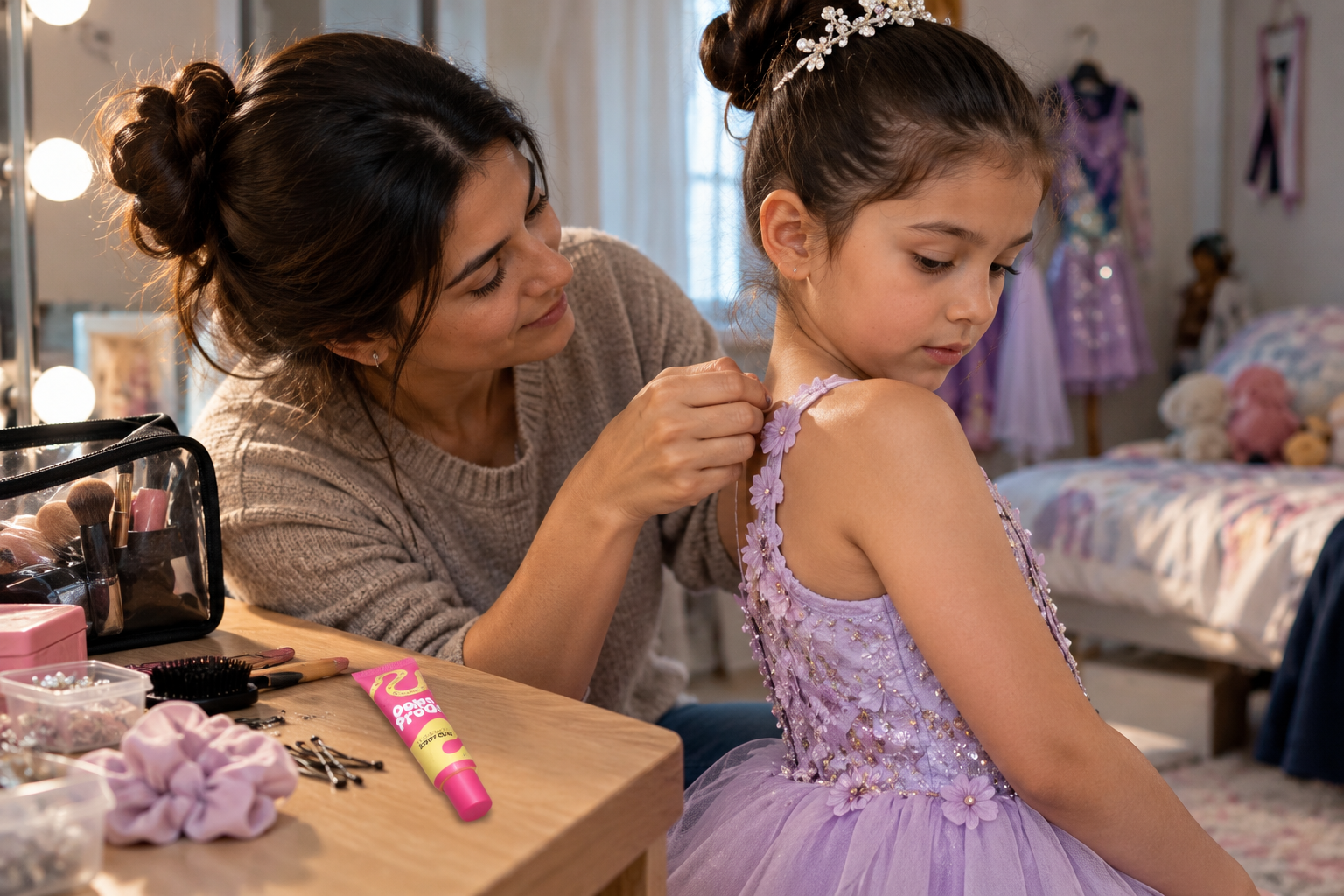
Little Outfit Problems, Big Distractions
A gaping button, a tie that has travelled sideways, a bandana sliding down over one eye. None of that looks serious to an adult. To a seven-year-old in an assembly line, it is the only thing in the room.
Watch a child fidget for ten minutes and you can usually trace it to one loose piece of fabric. The hem came untucked. The sock rolled down. Her attention is not on the teacher, the song or the ball.
Kids have no polite way of ignoring a wardrobe problem. They tug, scratch, pull at a collar, or quietly stop participating. Oops-proofing your kids’ outfits is less about neatness and more about removing that small distraction sitting between your child and whatever she is supposed to be doing.
School Uniform Fixes
The best school uniform hacks are boring, and they take thirty seconds. Uniforms fail in the same four places every morning.
- Button gaps on a shirt. A thin line along the placket keeps it flat, which means no flash of vest to the third row.
- Bandanas and scout scarves. Anchor the fabric at the shoulder point instead of the neck. That stops the sideways slide.
- Ties that drift by second period. A little under the knot holds it against the shirt, with no pin near a moving child’s throat.
- Long socks that surrender by 10 a.m. A thin line at the sock top and calf keeps them up through assembly, PT and the walk home.
- Shirt hems riding up. Two short lines at the sides hold a tucked shirt through sitting and bending.
These are the kids’ outfit hacks worth repeating, because they hold on a real timetable and not a photo shoot.
Halloween, Fancy Dress and School Functions
Costume day is where the outfit stops behaving. Capes drag backward, wings wobble, sashes slide, cuffs flap open, and a shoulder strap gives up somewhere between the class photo and the parade.
The fixes that last: anchor a cape at both shoulders rather than the neck, hold a sash at the shoulder point, and secure a belt end so it stops swinging. Do it before the costume goes on, not after the first tug.
Here is the caveat most guides skip. That glossy superhero cape is usually polyester satin, and slick fabric is exactly where body glue struggles. Test an inside seam first, or pick another method for those pieces.
Halloween makeup for kids needs its own rules. Face gems belong to a cosmetic product made for faces, applied by an adult, well away from eyes and mouth. Never put a fabric product above the neck. For the rest of the outfit, our roundup of Halloween party outfit fixes that skip pins and tape covers the fiddly bits.
Performances and Sports
Stage and sport are the same problem at higher speed. A costume that looks fine in a mirror moves differently once a child starts dancing, tumbling or sprinting.
| Moment | What goes wrong | What to anchor |
|---|---|---|
| Dance costume | Shoulder straps slip during lifts | Strap to shoulder |
| Gymnastics leotard | Leg line rides up on every tumble | Leotard edge to skin, thin line only |
| Football socks | Roll down | Sock top to calf |
| Teen stage wear | Pallu or backless blouse edge slides off | Shoulder point and blouse edge |
| Cape or wings | Drag pulls the neckline crooked | Shoulder points, not the neck |
Oops-proofing a performance outfit is really about three points that move most: shoulder, waist and calf. Fewer adjustments mean more focus. A dancer who is not hitching up a strap can hear the count in.
Kids do not need a perfectly pressed outfit. They need clothes that stay where they were put, so their attention can stay where it belongs.
Where Body Glue Fits In
Most outfit failures need one thing: fabric that grips skin instead of gliding over it. That is the entire job of body glue for clothes. At OopsProof we make a skin-friendly formula with aloe vera and glycerine, lab tested, that holds fabric and small accessories and then lifts off with water.
Application decides whether it works:
- Skin should be clean, dry and free of lotion.
- Apply a thin, even line along the whole area you are securing. A single dot will not hold anything.
- Wait 45 to 60 seconds until the line feels tacky. This is the step nearly everyone skips.
- Press the fabric down firmly for a few seconds, then bend and stretch once to test the hold before you leave the house.
Removal is water and a cloth. It dissolves, comes away clean, and needs no scrubbing. For a child’s bandana, sock top, tie or costume strap, that thin line often decides whether the morning has one adjustment or twenty. Older kids heading to a school function can use it on a pallu, a dupatta, a backless blouse edge, or jewellery that keeps turning. Do a small test patch first, always.
A Parent’s Safety Checklist
Adult-safe does not mean child-safe. A safety checklist for oops-proofing your kids’ outfits starts there. Skin is thinner, more reactive, and far more likely to be rubbed at during a long day. Read the directions and confirm suitability for your child’s age before the first use.
Test before you trust. A small amount on the inner arm, 24 hours earlier, tells you more than any label. Redness or itching means stop.
Keep it away from eyes, mouth and broken skin. No close calls. Face details are cosmetic territory, not fabric territory.
Supervise the first few uses, and skip it on hot, heavy-sweat days or for very young children. Our formula is sweat-resistant, not waterproof. A tube loose in a school bag with no instructions is a bad idea.
Frequently Asked Questions
Is body glue safe for children’s skin?
Check the pack directions and age guidance first, and patch test on the inner arm a day before. Skin varies a lot between kids, so adult supervision for the first few uses is a fair rule.
Can body glue help with school uniform problems?
Yes, for the fabric-to-skin moments: a bandana slipping off a shoulder, a sock rolling down, a tie drifting sideways, a shirt hem riding up. Heavy or very slick fabrics need another approach.
How do I keep long socks from rolling down?
Anchor the sock top to the calf with a thin, even line, let it go tacky for 45 to 60 seconds, then press. Test with a few knee bends before school, and skip it if there is any rash or broken skin on the calf.
What should I use for face gems in a kids’ costume?
A cosmetic product made for facial use, applied by an adult, away from the eyes and mouth. Fabric body glue is not the right product for a face, even when it is skin-friendly.
Try This Today
- Pick the one piece of clothing your child touches most during the day, whether that is the sock, the bandana or the tie. Fix that single spot tomorrow morning and watch whether the fidgeting changes.
- If you want the full technique, read the complete guide to body glue for clothes for application, drying time and removal.
- Start with OopsProof Body Glue. One tube covers 50 to 60 uses, so a school term of bandanas, sock tops and costume straps fits inside it. Keep it in the wardrobe next to the eight items every fashion emergency kit needs.
Then let it go. The whole point of oops-proofing your kids’ outfits is not a child who looks immaculate in every photograph. It is a child who is not thinking about her sleeve while she is on stage, on the field, or in the front row of assembly.

