
Your costume holds perfectly through every rehearsal, then shifts the moment the stage lights hit you and two hundred people are watching.
Quick take: Indian gymwear and dance costumes are cut for aesthetics, not for the physics of real movement under sweat. Necklines, dupatta pins, and crop waistbands fail within 20 minutes of active performance because no fabric fix accounts for body heat plus momentum. Skin-safe body glue applied before you dress is the one fix that moves with you instead of against you.
The Problem Nobody Names Out Loud
The wardrobe malfunction problem in Indian gymwear and dance costumes is almost never discussed publicly, because admitting it feels like admitting the costume doesn't fit. It does fit. The problem is physics, not sizing.
A Bharatanatyam dancer executes an aramandi, knees bent outward, torso upright, arms extended. Her blouse neckline was sitting perfectly thirty seconds ago. Now it has shifted forward two centimetres because her shoulder muscles pulled the fabric as her arms rose. She corrects it mid-sequence with a micro-adjustment that costs her a beat. The audience notices the hesitation, not the neckline.
A hip-hop crew member drops into a floor slide. Her crop top rides up. Her bandana, tied at the back of her neck, loosens from the sweat building at her hairline. She finishes the routine holding the fabric down with one arm during a move that was choreographed for both arms free.
These are not rare accidents. They happen at almost every performance because the costumes were never designed with adhesion in mind.
Why Kathak and Bharatanatyam Costumes Are Especially Vulnerable
- Dupatta and pallu placement: Pins hold fabric to fabric, not fabric to skin. The moment a Kathak dancer spins into a chakkar, centrifugal force pulls the dupatta outward. The pin holds the layer but the drape shifts anyway.
- Blouse necklines on open-back cuts: Classical dance blouses are often backless or low-cut at the back for range of motion. Without a back anchor, the front neckline has nothing to pull against during arm extensions.
- Ghungroo ankle weight redistribution: Heavier ankle bells shift a dancer's centre of gravity slightly. To compensate, the body leans forward, which pulls waistbands and hip-tied skirts downward by a centimetre or two over 45 minutes.
- Sweat accumulation at the sternum: Bharatanatyam generates intense heat. The sternum and collarbone area become damp within 10 minutes. Any tape or pin near that zone loses grip fast.
- Jewellery movement transferring to fabric: A maang-tikka that shifts pulls the hair, which pulls the head position, which subtly shifts the shoulder, which moves the blouse. It is a chain reaction that starts with one unsecured piece of jewellery.
The fix most dancers reach for is more pins. More pins add more weight, create visible bumps under thin fabric, and still do not solve the sweat-and-movement combination.
Hip-Hop Crew Costumes Have a Completely Different Set of Failures
Classical dance costumes fail because of drape physics. Hip-hop crew costumes fail because they were designed to look sharp in photographs, not to survive floor work, lifts, and eight-count sequences done at full speed.
Crop tops and co-ord sets are the standard crew uniform. They look clean in the team photo. By the third run-through of a routine that includes body rolls, the crop top has migrated two inches above where it started. The waistband of the co-ord bottom has rolled down at the front because the fabric has no grip against skin that is warm and slightly damp.
Bandanas tied at the neck or worn as headbands are another consistent failure point. The knot loosens under sweat. The fabric slides. A dancer whose bandana is slipping spends mental energy on the costume instead of the choreography, and that split attention shows in the performance.
Your costume doesn't fail at rehearsal. It fails at the exact moment the lights come on and the music starts.
Socks are a smaller but real problem too. Ankle socks worn with sneakers roll down inside the shoe during footwork-heavy sequences. It sounds minor until you are mid-routine and the bunched fabric is pressing against your heel with every step.
Why Gymwear Malfunctions Are the Least Talked About of All
At least dancers expect costume challenges. Women in gym settings often do not. Gymwear is marketed as performance fabric, which creates the assumption that it will stay put. It frequently does not.
| Gymwear Piece | Where It Fails | Why It Fails |
|---|---|---|
| Sports bra neckline | Shifts forward during overhead press or pull-up | No adhesion to skin, fabric follows arm movement |
| Racerback strap | Slides off shoulder during lateral raises | Sweat reduces friction between strap and skin |
| High-waist legging waistband | Rolls down during deadlifts or deep squats | Waistband tension fights hip flexor movement |
| shorts | Rides up during squats or running. | Vertical movement with no skin anchor |
The gymwear industry's answer to this is compression fabric. Compression holds shape but does not anchor fabric to skin. The moment you sweat enough to reduce friction, even compression fabric shifts.
If you have ever pulled your sports bra back into place between sets and hoped nobody noticed, you already know this problem firsthand. For a deeper look at how body glue works across gym, office, and everyday outfit situations, the fix is simpler than most people expect.
What Actually Works: Anchoring Fabric to Skin Before You Move
The single insight that most costume guides miss: the problem is not the fabric, the pin, or the costume design. The problem is that nothing is anchoring fabric directly to skin. Pins connect fabric to fabric. Tape connects fabric to fabric. Neither accounts for the skin moving underneath both layers.
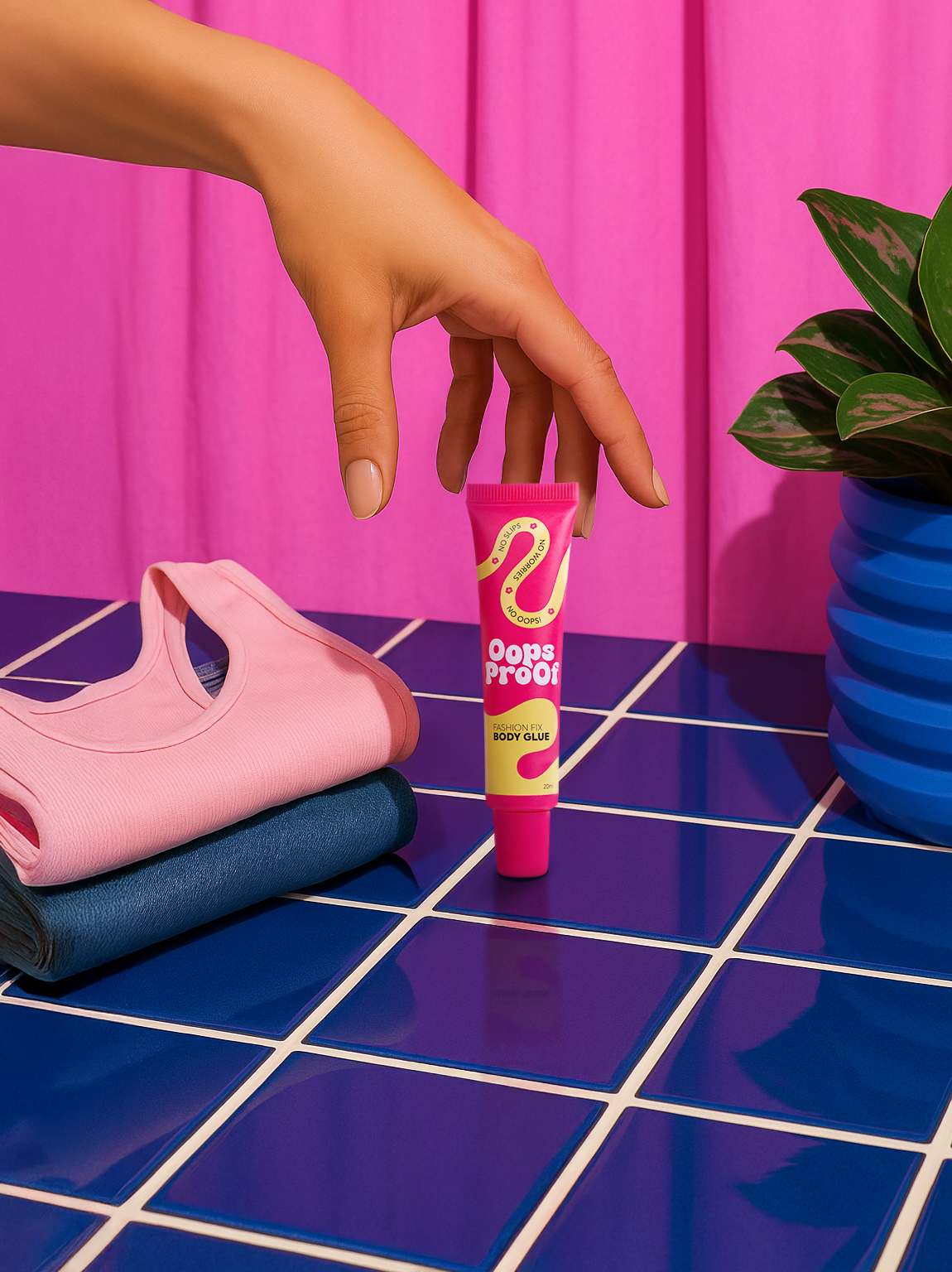
Body glue applied to skin before dressing creates a direct bond between fabric and the body itself. When the shoulder moves, the blouse moves with it rather than against it, because both are attached to the same surface.
At OopsProof, we hear from dancers and gym-goers who tried fashion tape first and found it peeled within 20 minutes of active movement. The difference with body glue is the bond mechanism: it grips skin chemistry, not just surface contact, which means sweat does not immediately break it. You can read a full breakdown of why fashion tape fails under sweat and what holds longer if you want the side-by-side comparison.
For dance costumes specifically, the application points that make the biggest difference are the sternum (for necklines), the shoulder blade edge (for backless blouses), the hip crest (for skirt waistbands), and the collarbone (for dupatta or pallu placement). Jewellery like a maang-tikka can be secured at the hairline contact point to stop the chain-reaction shift described earlier.
OopsProof body glue is skin-safe, lab tested, and water-removable, so it wipes off cleanly after the performance without pulling at skin. The formula contains aloe vera and glycerine, which means it does not dry out the skin during a two-hour rehearsal session. Apply a thin layer, wait 60 seconds until tacky, press the fabric down, hold for a few seconds. That is the entire process. Always do a patch test on your inner arm 24 hours before first use.
One thing worth knowing: less product holds better than more. A thick application traps air and weakens the bond. A thin, even layer is what actually stays through a full Bharatanatyam recital or a hip-hop showcase.
Frequently Asked Questions
Can body glue damage delicate dance costume fabric?
OopsProof body glue is water-soluble and wipes off skin cleanly. For fabric, apply it to your skin only, not directly to the costume material. The fabric rests against the tacky skin surface, so the costume itself never contacts the glue directly and stays undamaged.
How long does body glue hold during an active dance performance?
OopsProof holds 6 to 8 hours under normal conditions. For high-sweat performances, apply to clean, dry skin and allow the full 60-second tack time before pressing fabric down. Skipping the 45-60 second wait step is the most common reason hold time drops significantly.
Is body glue safe to use on the chest and collarbone area?
Yes, when the formula is skin-safe and lab tested. OopsProof uses aloe vera and glycerine as core ingredients, both of which are gentle on skin. Patch test on your inner arm 24 hours before using it on more sensitive areas like the sternum or collarbone.
Can I use body glue to secure jewellery like a maang-tikka or earring backs?
A small amount applied at the contact point between the jewellery and skin or hair works well for lightweight pieces. It stops the chain-reaction shift where a sliding maang-tikka pulls hair, which shifts the shoulder, which moves the blouse. Remove with water and a soft cloth.
Does body glue work on synthetic gymwear fabrics like polyester or spandex?
Body glue bonds to skin, not fabric, so the fabric type matters less than people assume. Polyester and spandex both sit against the tacky skin surface and hold. The one variable is how quickly the fabric wicks sweat away from the skin surface, which affects how long the bond stays active.
Try This Today
- Before your next rehearsal or gym session, apply a thin layer of OopsProof to the one point that shifts most, your sternum for necklines, your hip crest for waistbands, or your collarbone for dupatta placement. Wait 60 seconds, press the fabric down, and run your warmup. Notice the difference before the full session starts.
- If you want to understand exactly how the application process works for different outfit types, the step-by-step breakdown on why body glue for clothes stops working and the 60-second skin step that fixes it covers the most common mistakes in detail.
- Pick up OopsProof at oopsproof.co and try it for one performance. One tube covers 50 to 60 uses, so a single purchase takes you through an entire dance season without rebuying.

