
You've checked the neckline in the lift mirror, the car window and the restaurant washroom, all within four hours. The outfit still hasn't earned your trust, and the evening is halfway gone.
Quick take: Fashion tape anchors one fixed strip, so every other spot on that neckline still moves. Sweat and oily skin make the edges lift faster. Spread a thin line of body glue across the whole area instead, and the hold follows your outfit, not a pre-cut rectangle.
Your Outfit Shouldn't Need Constant Supervision
Almost everyone has a short list of clothes she loves but doesn't entirely trust. The strapless top that needs a hoist every twenty minutes. The kurta whose placket gapes the second you sit down. The backless blouse that became a full-time job by 8 pm.
So you supervise it. A tug before you stand. A palm over the dupatta while you cross the road. A mirror detour between courses, not for lipstick but for a strap that has wandered. From outside it looks like nothing. Inside your head it's a second job.
The cost isn't the adjusting. It's the split focus. You're mid-sentence with your manager and part of your mind is on a neckline. Ask anyone who has done a twelve-hour day in an outfit she couldn't trust: the outfit wins.
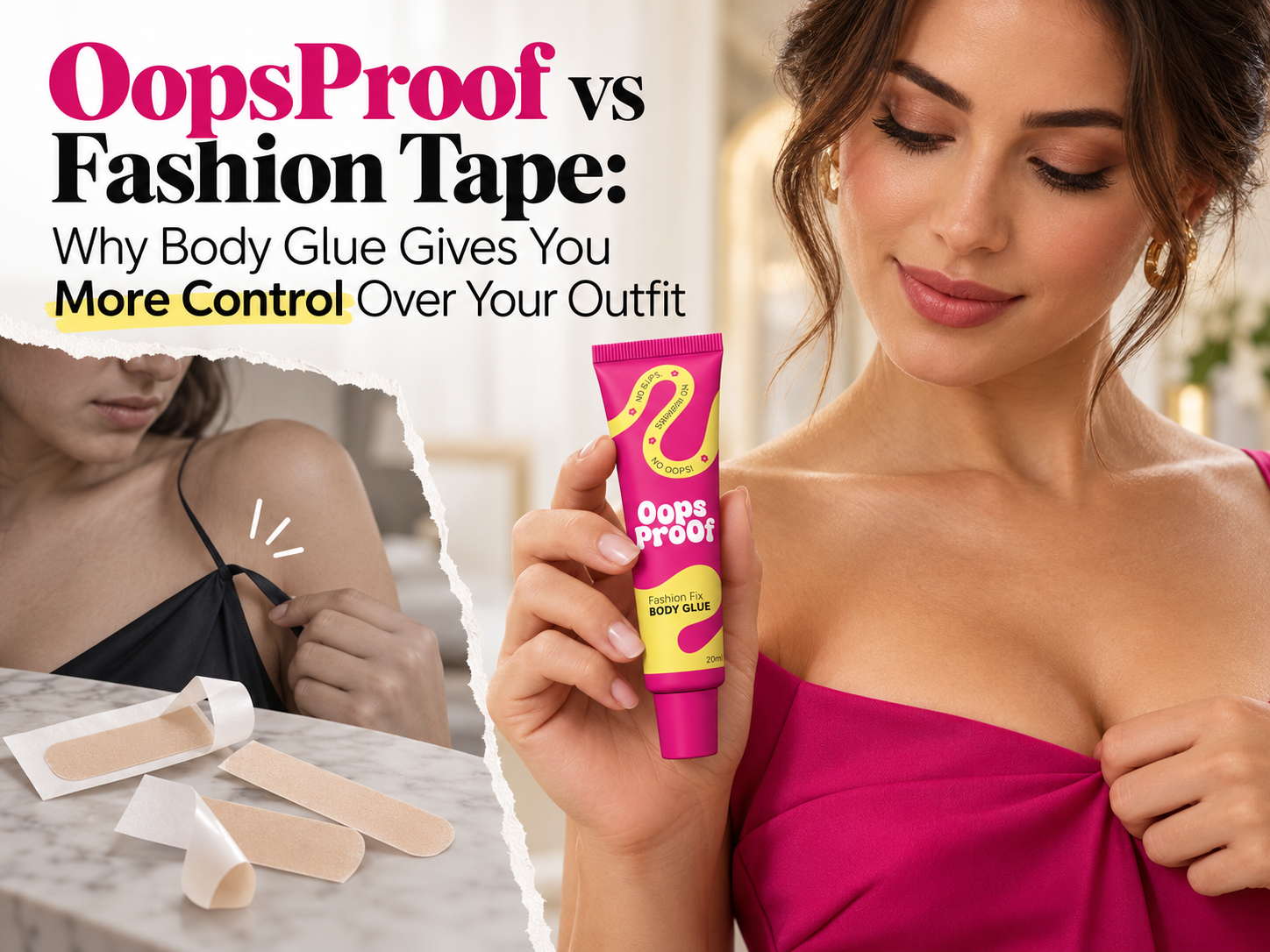
Tape answers half of that, holding only the exact spot you stick it on. Most OopsProof vs fashion tape questions start right here, with a strip that quietly gave up around hour three.
One Body, Many Needs
Two women can wear the same neckline and need completely different fixes. A petite frame with a deep V has a short gap to bridge. A fuller bust has weight pulling fabric down all evening. Neither problem fits a pre-cut strip that comes in one size.
- Small frame, plunging neckline: a strip strong enough to hold tends to peek out or leave a ridge under thin fabric.
- Fuller bust: gravity does the pulling, and a narrow rectangle is a small answer to a heavy load.
- Sloping shoulders: the strap travels its whole length, so one anchor point doesn't fix the path.
- Open backs and cutouts: the point is that nothing shows, and tape edges show.
Body glue flips the logic, because you draw the line yourself. Short line for a shallow V, a longer sweep along a full neckline, a small amount where a strap meets the shoulder. You aren't picking between sizes someone else manufactured.
Stylists work this way too. A growing group of fashion stylists now picks body glue over double-sided tape, since a fitted bodice on a shoot can't handle a visible edge or a strip that fails between takes.
Oily Skin, Sweat and Indian Weather
Tape rarely fails in the middle. It fails at the corners. Sweat and skin oils gather along the strip's edge, a corner lifts by a millimetre, air gets underneath, and the rest follows. A humid afternoon in Chennai or a packed Delhi metro coach speeds that up.
It goes on as a thin line straight onto clean, dry skin, with no backing to curl at the edge. Hold runs along the length you applied instead of depending on one sealed border. It's sweat-resistant rather than waterproof: a long sticky day is fine, a shower is not.
Skin decides plenty too. Oily skin, lotion applied five minutes earlier, a hot kitchen, a dance floor, all of it changes how long any hold survives. Put the two side by side on a humid day and the weather votes louder than brand loyalty.
Tape peels at the corners first, usually within two hours. Body glue holds along the whole line you drew, because there's no edge for sweat to creep under.
Your Outfit, Your Silhouette, Your Rules
Comparing the two area by area is also how you'll work out how to keep clothes in place on the day.
| Area to secure | Where tape struggles | What body glue can do |
|---|---|---|
| Plunging or loose neckline | Holds one point, the rest still gapes | Runs along the full curve you need held |
| Off-shoulder and slipping straps | Bunches up under the strap | A thin line follows the strap's path |
| Saree pallu | Needs several strips, edges show on silk | Light line under the pleats at the shoulder, invisible once dry |
| Backless blouse | Any visible edge spoils the line | Dries transparent, so the back stays a back |
| Bandana, socks, jewellery | Too wide and too visible for small items | A dot or short line keeps a clasp or sock edge put |
One honest caveat in any OopsProof vs fashion tape comparison: skip body glue on satin and leather. Those surfaces behave differently and friction works against you. Tape isn't brilliant there either, so treat this as a limit, not a pitch. Cotton kurtas, chiffon dupattas and gymwear are fair game.
What About Sensitive Skin?
Anything sitting on skin for eight hours deserves a look at the label. OopsProof is made with aloe vera and glycerine, is lab tested, dries transparent and lifts off with water and a cloth. No scrubbing, no residue on the blouse.
Your skin is personal, though. Some people react to products the majority tolerate easily, and no brand can promise otherwise. Patch test first: a small amount on the inner arm, wait 24 hours, then check for redness before a full neckline.
Most of the hold comes from application, so treat these steps as part of the product:
- Start on clean, dry, lotion-free skin. Moisturiser and oil sit between the glue and your skin.
- Spread a thin, even layer over the entire area that needs hold. A single dot will not secure a neckline, however much you use.
- Wait 45 to 60 seconds until the film feels tacky. This is the step everyone skips.
- Press the fabric down firmly, hold a few seconds, then bend and stretch once before leaving the house.
More Control, Less Outfit Anxiety
Try a small experiment: count how often you touch your outfit in a day. The strap tug, the pallu straighten, the sock push. Most of us lose count before lunch, and none of those touches are the problem. Each one pulls your attention out of the room you're in.
At OopsProof, we hear the same story constantly. A work dinner spent sitting at an angle because a side seam opens whenever she leans forward. She wasn't in the conversation. She was on the seam.
Control is the real gap between these two. Tape gives you a yes or no: one strip, one spot. Body glue gives you a dial, more coverage where fabric is loose, less where it's snug. A running count of how many times you adjust your top shows which one you actually need.
Frequently Asked Questions
OopsProof vs fashion tape: which one should I pick?
Pick tape for a quick fix on light fabric in a cool room. Pick body glue when the area is larger, the day is long, or a visible edge would spoil the outfit.
Can body glue hold a saree pallu?
Yes, with proper application. Run a thin line along the shoulder where the pleats sit, wait until tacky, then press. Very heavy silks may still shift, so test before a function.
How long does OopsProof last?
Usually 6 to 8 hours, depending on skin, sweat, fabric weight and prep. It's sweat-resistant, not waterproof, so a shower breaks the hold.
Will it leave marks on clothes?
It's water-soluble and lifts off fabric with water and a cloth. For delicate pieces, test a hidden inner seam first.
How to choose
- If the fabric is light, the room is cool and the fix only needs two hours, a tape strip is fine. If the outfit has to survive sweat, dancing or six hours plus, body glue is the better bet.
- Test it on the outfit sitting unworn in your wardrobe, the one you like but don't trust. OopsProof skin-friendly body glue is water-soluble, dries invisible and removes with a damp cloth, so a first try costs one evening.
- Still weighing it up? The complete guide to body glue for clothes covers fabrics, hold times and application in more detail.
That is the short version of OopsProof vs fashion tape: match the product to the outfit, not to the trend. One tube runs 50 to 60 uses, which is worth doing the maths on if you've been buying tape strips four at a time. The real payoff isn't adhesion. It's leaving the house without a backup plan in your head.
OopsProof it. Wear it. Forget it.

